
Why Natural Cork?
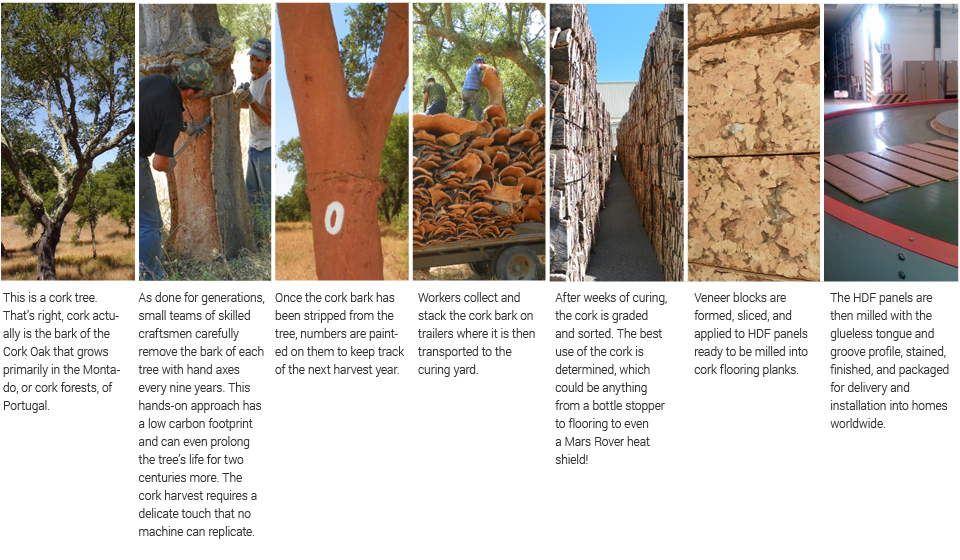
Natural Cork is enjoying a resurgence in popularity today. From television design shows to shelter magazines, Natural Cork is seemingly everywhere and ostensibly the “hottest new product” on the market.
Many people think of cork as a relatively new and possibly unreliable option particularly as a surface flooring material. And yet, there are examples of Natural Cork floors in public buildings that were installed over 100-years ago and are still in use today. The Library of Congress in Washington, DC is one excellent case.
THE NATURAL CORK TREE
A member of the beech family, Quercus Suber or the cork oak tree grows in coastal regions of the Mediterranean. Seven countries comprise the bulk of the area where cork oak will grow. These countries are Portugal, Spain, France, Italy, Algeria, Morocco, and Tunisia with the majority of the production occurring in Portugal and Spain. Relatively slow growing, cork trees survive harsh conditions in depleted soil that will often support little else of value. There are examples of cork oak trees that are 400 to 500 years old, though the average life expectancy would be 120 to 200 years.
Unlike most trees where primary value is derived from the lumber of the trunk, Natural Cork is actually obtained from the bark of the tree. This unusually thick bark is made up of millions of tiny prism-shaped air pockets which create a resilient cushiony surface that offers several distinct advantages to the tree. Natural Cork is a natural fire inhibitor so the bark provides protection from wildfires common to the region. An inherent waxy substance, suberin, serves as an insect repellant eliminating threat from many usual agricultural pests. And the bark is regenerative, so its protective properties will grow back if damaged in any way.
A PROUD HISTORY
Natural Cork has a long and distinguished history as an agricultural product. In ancient times, cork bark was used to form sandal soles, food storage vessels, and floats for fishing nets. There are mentions of cork and its uses in many ancient documents and literature surviving from as far back as 400 BC.
Seventeenth century French monk, Dom Perignon, is credited with being the first to recognize the ability of cork to contain sparkling wines. This discovery is responsible for establishing development of cork bottle-stopper production into the important industry it is today. Over time, cork became more and more important as a cash crop resulting in governmental regulation offering protection and placing restriction on ownership, production, and harvesting.
Rulers in Portugal were quick to recognize the economic value of cork and took early steps to secure its benefit for themselves. By the 14th century, ownership, growth, harvest, and sale of cork was closely regulated, even to the point of dictating how windfall branches could be disposed of. Many of these restrictions are still in place and can surely be credited with the strength of Portuguese cork production in the world economy. Portugal is the leader in corkwood farming at more than 50% of production and is responsible for many of the internationally adopted protective measures governing the growth and manufacture of Natural Cork. In Algeria and Tunisia, cork trees were not offered similar protection which resulted in almost complete deforestation by the turn of the last century. An effort to replant the region has experienced some success.
NATURAL CORK AGRICULTURE
Grown on farms and harvested every 9 to 11 years, the financial benefit lies not in felling these trees but in keeping them alive and in production for generations.
Regulations necessitate that a cork tree may not be harvested until it is 20 to 25 years old. The material from this first harvest is known as “virgin” cork. Virgin bark is less desirable as it is tough and irregularly formed. The next harvest results in product that is called “secondary cork” which, though of better quality than virgin bark, is still not ideal. After extracting these first two layers of cork, subsequent harvests produce “amadia”. With the harvest of amadia, a cork oak tree has reached its optimum production value. At maturity a typical tree can produce upwards of 450 pounds of cork per harvest. This takes right around 50 years to achieve. Starting a cork tree farm is an investment in future generations.
Often cork farms are combined with other forms of agriculture such as raising pigs or growing another crop in and among the trees. These combinations work well for local farmers to balance the protracted production cycle of cork farming.
Natural Cork is still harvested by hand in the traditional method leaving the habitat intact and with minimal impact on the overall environment. Removal of the bark, known as “stripping”, must be done during the active growing season, June through August. Using hand tools, a series of cuts are made in the bark, one at ground level, one just below the first branches, and two vertical cuts joining these. The loosened bark is then pried off in two large sheets where possible and smaller bits if not. Sheets of cork are stacked and left for days to dry in the sun, before being sent to factory.
THE FLOORING OPTION
The ability to use cork in flooring applications was not discovered until the 19th century when American, John Smith, discovered agglomerated cork. Today, cork flooring is created from the post-industrial by-product of the bottle-stopper industry. This ‘waste’ material is ground up and then formed into sheets using minimal amounts of adhesive to bind the particles together under high pressure. The size, quantity, and type of cork granule in conjunction with varying degrees of pressure make the difference between “bulletin board” material and material suitable for flooring applications.
Historically, cork floors were finished in the same manner as any other wood flooring, i.e. with a paste wax buffed into the surface. However, the labor-intensive nature of this maintenance routine was seen as a real drawback when rolled sheet vinyl and similar ‘modern’ resilient surface options came on the market in the mid 20th century. Cork flooring fell out of favor and for perhaps 30 years was not readily available to the general public.
New finishing techniques and improved technologies have revived interest in cork over the past decade. Though still a small fraction of the overall floor coverings market, Natural Cork is enjoying a resurgeance in popularity driven in large part by consumer demand. What does cork have to offer that sets it apart from other flooring choices? Quite a bit it turns out. In fact, no other floor covering can match the combined benefits of cork.
COMPARISON CHART
Natural Cork floors combine the best characteristics of hard surface and soft surface flooring. NO OTHER FLOORING OPTION COMPARES! See for yourself:
| Natural Cork | Carpet | Hardwood | Ceramic Tile | Vinyl/VCT | Laminate | |
| Warm | Yes | Yes | No | No | No | No |
| Comfort Underfoot | Yes | Yes | No | No | No | No |
| Durable | Yes | No | Yes | Yes | Yes | Yes |
| Easy to Clean | Yes | No | Yes | Yes | Yes | Yes |
| All Natural | Yes | No | Yes | No | No | No |
| Resilient | Yes | No | No | Yes | Yes | No |
| Mold/Mildew Resistant | Yes | No | No | No | No | No |
| Acoustic Insulator | Yes | Yes | No | No | No | No |
| Thermal Insulator | Yes | Yes | No | No | No | No |
| Increases Home Value | Yes | No | Yes | Yes | No | No |
| Resists Insects | Yes | No | No | Yes | Yes | No |
| Fire Inhibitor | Yes | No | No | No | No | No |
| Easy to Install | Yes | No | No | No | No | Yes |
| Easy to Repair | Yes | No | No | Yes | No | No |
| Scratch Resistant | Yes | NA | No | Yes | No | Yes |
PRODUCT SELECTION
The basis for Natural Cork flooring is agglomerated sheet material produced mainly in Portugal and Spain. This material has the appearance of compressed granules, which is exactly what it is. In order to achieve a different appearance, it is necessary to laminate a thin veneer layer of cork on top of this core material. Lamination takes place at the time of original production making the thin layer inseparable from the core. The veneer layer carries the pattern. There are many patterns to choose from, everything from those that favor bamboo to those that mimic marble and much in-between.
NATURAL CORK PARQUET TILE – Glue-down tile, often referred to as parquet, is generally available in a range of patterns and colors, finished or unfinished, 12″ x 12″ or 12″ x 24″ are standard. It is possible to special order in other sizes up to 36″ x 36″ which is the limit of the production machinery. Tile can be installed over wood or concrete substrates that meet the qualifications for sheet vinyl applications. The preferred method of adhesion is water based contact cement, however other adhesives are used. It is not recommended to install tile in below grade situations.
NATURAL CORK PLANK – When applied to cork, the term ‘plank’ refers to a floating floor installation, where cork has been laminated to a fiberboard center core with a tongue & groove edge. This allows for several advantages:
1. Subfloor preparation is less stringent
2. The floor ‘floats’ and is less visibly affected by expansion and contraction normal to wood products
3. Plank can be installed below grade
4. Installation is relatively quick
5. Thicker product provides better insulation
As is common with other floating products, Natural Cork plank requires a perimeter expansion space that must be covered by baseboard or other trim. The necessity for perimeter expansion makes it difficult to use plank in a place where it will not be convenient to install trim pieces. This is particularly true in most bathrooms where roll-edged tubs and floor-mounted toilets are common. Therefore, it is recommended to use Natural Cork tile in bathroom applications.
Natural Cork plank products are milled with a specially shaped “click” together tongue & groove center core. This sophisticated and highly accurate milled shape ensures a very tight connection during installation and beyond. Click technology is a glueless installation resulting in less mess, less fuss and less time on the job. What’s more, floors that are clicked into place and also be unclicked for easy repair.
UNDERLAYMENT – Cork underlayment is used specifically for its ability to provide acoustic insulation. Available in both rolls and sheets, underlayment is used beneath other surface flooring to decrease noise transmission and impact sound. With ceramic tile, cork underlayment can also reduce stress-related cracking.
WHAT TO LOOK FOR:
DENSITY – Product density is determined by the size of the cork granules used. Larger granules have fewer voids to be filled by binding agents and therefore produce a higher density cork. Large cork granules, with high density, are used as the top layer of all Natural Cork floating floors and parquet tiles to ensure the durablity of the floor. Lower density cork is only used on the bottom layer of the floating floor plank for added thermal, acoustical, and mold resistance properties.
FINISH – Natural Cork can be purchased unfinished but, unlike some wood, it must be finished upon installation. Though some people continue to prefer paste wax, the most common finish today is polyurethane. There are suppliers who offer cork with a vinyl coating that is low maintenance but cannot be refinished or easily repaired. The latest development in finishes is “anti-scratch”, a more durable coating. Cleaning and maintenance products are available from USFloors.
THICKNESS – The thickness of the Natural Cork wear layer has less to do with durability than will density. However, it will be a source of improved insulation both acoustic and thermal. A good standard thickness is 4 mm for parquet tiles, while a 3 mm top layer and 2-3 mm bottom layer is good for floating floors with an HDF core.
MAINTENANCE
With Natural Cork, lasting beauty can be achieved through purchasing a top quality material and providing proper on-going maintenance.
Providing proper maintenance begins with remembering two key properties of cork, its ability to fade with exposure to light and the fact that it will react to heat and humidity.
Natural Cork contains organic pigments. Just like other wood products, Natural Cork will fade over time and should never be exposed directly to sunlight. Use drapes or other systems to protect your floor from excessive light will slow down this process. Cork will naturally yellow or mellow with age. Uneven exposure to light sources will cause uneven ageing so it is a good idea to rotate furnishings periodically.
All wood floor systems expand and contract in response to fluctuations in temperature and humidity. By controlling the environment, maintaining a moderate temperature and relative humidity around 50%, one can minimize the visible effects of the normal contraction and expansion of your floor. It is important to sweep or vacuum the floor regularly in order to avoid build up of abrasive particles that can scratch the finish. Most cleaners specified for use on pre-finished hardwood will also work with Natural Cork, but be sure to read packaging for correct information. These cleaners should be sprayed or misted over the surface and damp-mopped up as you go. It is not a good idea to use the old “bucket and mop” cleaning method on a Natural Cork floor. Spills should be wiped up immediately.
In the kitchen, use a non-rubber backed rug in front of working areas such as in front of the stove and sink to prevent local premature wear. Weight distribution is a key factor in preventing indentation. To minimize impressions in the resilient cork, furniture should have proper protectors under feet and furniture with casters should have wide casters. Protective mats are a good idea under office chairs.
REFINISHING OPTIONS
Most Natural Cork decorative patterns are made of thin veneer laminated to a cork base. Failure to maintain the finish could result in irreparable damage to this pattern layer. The longevity of the finish can be directly related to traffic intensity and quality of floor care. When a Natural Cork floor starts to show a traffic pattern and signs of wear, it is time to renew the finish.
URETHANE – For Natural Cork floors finished with an acrylic finish, a new coat of polyurethane will make the floor look new again and prolong its lifespan. The entire floor will need to be gently abraded and thoroughly cleaned before applying one or two coats of high quality water based polyurethane. The finish will then need to cure for a minimum of 48 hours prior to replacing furniture or receiving heavy traffic. Greatest success will be achieved through hiring a qualified flooring professional for this process. Under normal use in a residential environment, a urethane finish should last between 8 – 10 years between refinishing.
It is possible to stain or paint your Natural Cork floor at the same time you reapply a polyurethane finish provided you are able to buff through all layers of finish and get down to the raw cork without sanding through any applied veneer. Raw or unfinished cork will accept stain and paint formulated for use on other wood products. A roller application will offer the best chance of complete and even coverage. Lap marks are likely to show up so careful attention to detail is important.
COMMERCIAL – For commercial applications, anti-scratch water based finishes perform well and are easier to maintain and resurface than traditional acrylic coatings.
WAX – When necessary, wax finished floors will need to be stripped and have a new coat of paste wax buffed into the surface. Not all paste wax is appropriate, so be certain that use on Natural Cork is specified on the product label. In most cases this will be necessary every 18 months to two years. Polyurethane cannot be applied to a previously waxed Natural Cork floor as wax penetrates deeply into the material and will not allow urethane to adhere properly ultimately causing the finish to delaminate.
Natural Cork that has been finished with curable oil or hardwax oil will be cared for through spot application of maintenance products to traffic areas only. Provided the finish is properly maintained, it will not be necessary to strip and refinish an oiled cork floor.
OTHER NATURAL CORK PRODUCTS
Natural Cork has an amazing number of uses in the arena of home decoration.
Natural Cork wall tile is available in a variety of interesting patterns and colors that will lend an air of distinction to any room. Natural Cork tile is glued onto a prepared (clean, smooth, dry, primed) wall using contact cement. This product is protected with a wax film that repels dust and stains, but will allow tacks to be used. In addition, rolled sheet cork can be painted or stained and used to cover walls.
Wallpaper is another use for cork veneer. Several major wall covering companies, including York Wallcoverings, carry a variety of wallpaper featuring an astonishing range of colors, patterns, and composite blends to include such materials as straw and seagrass. These exotic room finishes can evoke a look similar to everything from lizard skin to metallic streaked marble. Cork wallpaper is installed and maintained in the same way as other non-vinyl coated wallpapers.
An unusual use of cork is in the realm of upholstery material. Kravet Design carries a line consisting of over 21 colors and patterns of cotton/poly backed upholstery fabrics. These materials are suitable for use on soft furnishings, pillows, as drapes and other window coverings, as well as decorative accessories. A factory applied finish similar to Scotch Guard offers protection from stains as well as water resistance. Maintenance consists of vacuuming and wiping down with a damp cloth as needed.
Background c/o USFloors